Thanks to Isabel for this report
For a long time, Jeff and I have been talking about making what feels like every orienteer’s life pilgrimage… a trip to Sweden’s annual O-Ringen orienteering competition. This year, we finally did it and what an incredible experience it was!
O-Ringen is the world’s largest orienteering event – I’d call it a festival really. This year, the busiest day of competition had 14,500 competitors – no, that’s not a typo! While the orienteering itself is the main draw, the logistics around the whole festival is almost as mind-boggling.
2026 was based on the edge of Gothenburg, with ‘O-Ringen City’ set up on a vehicle driving track. There were 2,000 camping pitches around the driving track and in fields adjacent, all marked out and numbered. While we went lightweight with tent and backpacks, it transpired that to do O-Ringen camping ‘properly’, you need a large caravan, an equally large awning, tables and chairs (maybe a sofa too) and of course your bikes, to make getting around the campsite easier. Indeed, we did a lot of walking over the ten days that the camping was open… 200m to toilets and water; and over 1km to the campsite showers. (Many competitors also stay in hotels, self-catering etc nearby.)
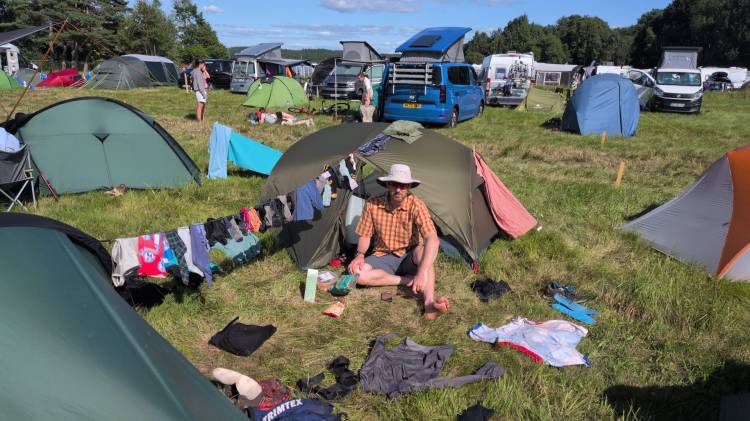
O-Ringen City was the location of all the vast array of on-the-side services and activities. To mention just a few… shuttle buses to each day’s competition arena (23 convoys of 5 buses each running from 0630 until the end of the day!), laundry, enquiries, various hot food options, disc golf, volleyball, yoga, massage, choir, O-Ringen radio station, shuttle bus to the nearest beach for swimming, and even a ‘church’ where you could be legally married or baptised!
The camping opens four days before the orienteering starts and this was great as we could find our feet, do some exploring in Gothenburg and get out on the two training maps as well. Public transport in Gothenburg was impressively integrated and of course, being Sweden, they had even upped the frequency of the two public bus routes which passed O-Ringen City, for the duration of O-Ringen. A beautiful first training area scattered with small lakes was great fun and provided the most sublime post-training swim in soft, perfect-temperature water. The second training area was adjacent to O-Ringen City and was rockier and dense with knolls – not 100% dissimilar to somewhere like Haverthwaite Heights.
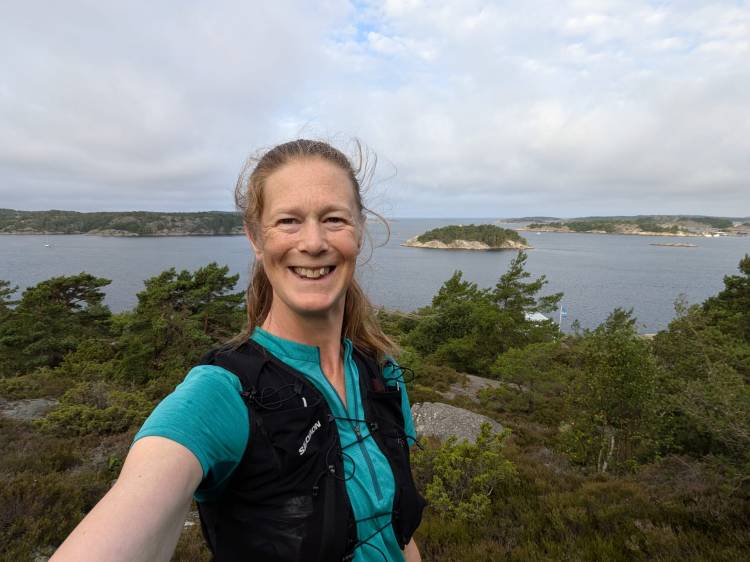
Getting out on the training maps proved useful as we entered into the five competition days. Days 1 and 2 were at the same arena; long distance events with fab terrain which rolled and knolled, and had good scatterings of crags and boulders, as well as plenty of tussocky marsh. There were just enough line features to capture you if needed, although relocation from one of these would have required very considerable time loss, so my strategy was not to get lost! Courses tracked up pretty fast, which was particularly useful through the tussocks, but there were a lot of tracks, and a lot of people dashing around in all directions, so if you chose to follow a track, you needed to be very sure it was going in exactly the direction you needed.
At each arena, showers are set up for post race; these are super impressive and were a million times better than showers at the campsite. Built on pallets with plastic sheeting to drain the water underneath, and 40 odd shower heads along the central water pipe (and I presume identical in the men’s) there was a constant flow of high pressure, hot water for 10,000+ competitors to wash in over around 5 hours each day. The first two days these were set up in an ice hockey arena! with the remaining three days on car parks.
Days 1 and 2 were followed by a rest day, which felt early on to have one, but we participated in indoor orienteering first thing, which was incredibly challenging to the brain, but enormous fun… winning time 10-15 mins; my time 50 mins. We then headed out to some of the islands off Gothenburg for the rest of the day.
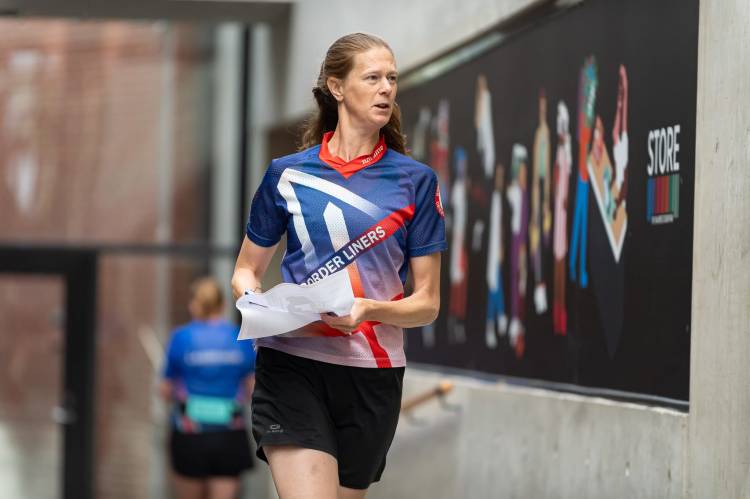
Day 3 was a middle distance race in a park in Gothenburg; think something a bit like Hampstead Heath but with more hills and crags, and more trees. I had the very last start minute of the day (seven different starts each day, with each starting around 10 people a minute) and this proved pleasant, as there were slightly less people in the terrain than there would have been earlier in the day. Much more runnable than days 1+2; think Lakeland Wednesday night sort of territory; enough to keep you on your toes, but contour detail you could read (on the map and on the ground) without too many brain gymnastics.
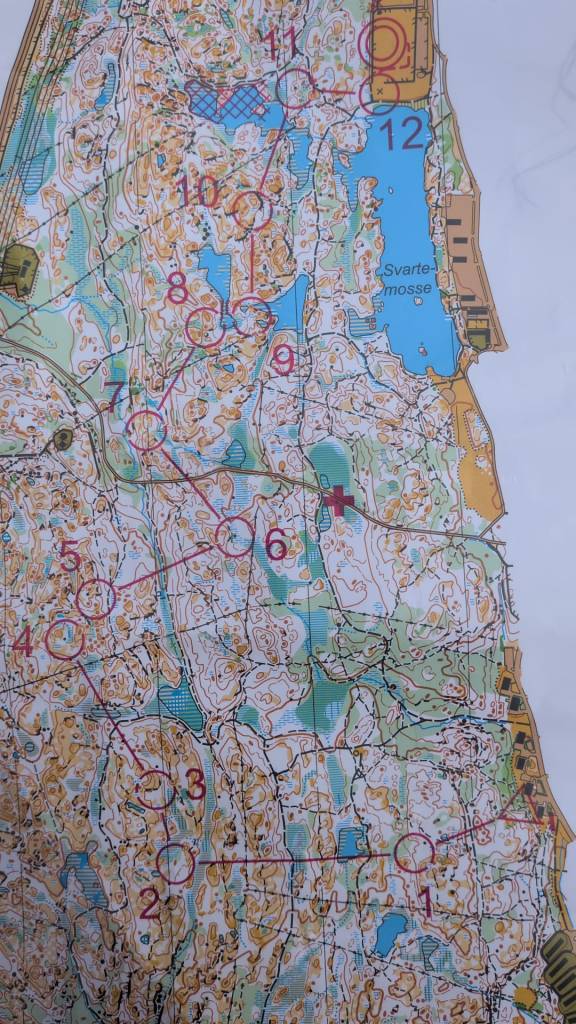
Days 4 and 5 shared the same arena and were flatter, with lots of small open areas, knolls and crags, interspersed with lots of small areas of marsh and woodland; the effect for me was that visibility felt lower and features were smaller, so harder to distinguish. However, there were a few more line features – paths and broken walls than days 1 and 2. Day 5 was a chasing start, with anyone more than 90 minutes of cumulative time slower than the class leader, set off at 15 second intervals thereafter. I wondered how chaotic this would make the starts but it was remarkably smooth and once in the forest, I only found myself running in a chain a couple of times.
Overall verdict: An absolutely fantastic week. Without writing a complete essay, it’s impossible to say everything about it or to convey quite how remarkable it all felt, but I would recommend it absolutely; I was surprised how few Brits there actually were there. We’re already thinking about O-Ringen 2027, which is at Stockholm; the maps look insane… will you be joining us?!

